I · The Farm
The land plan.
What the ground is like, how it is divided, and what gets done when.
The land now
The main farm runs from about 2,370 to 2,900 feet. It is steep. The typical slope is close to 50 percent, and most of the farm is steeper than 35 percent.
Most of it is forest, pine and hardwoods. It was a tobacco farm, and the old tobacco barn still stands on the upper part of the land. The open ground is small: the farm yard, a few old fields and the terraces cut in 2024.
A creek runs through the middle of the farm, and springs come out of the hillsides. There is an old spring house across the creek. Spring and creek flow will be measured every month for a year before any decision on a small hydro turbine.
The soil is thin and rocky. The best vineyard ground is a band of south and southwest slopes on the north side of the creek. Some higher ground is mostly rock outcrop and will stay in trees.
Erosion is the main thing to watch. The first stretch of the drive is very steep, and the terraces need their banks seeded. Along the west edge, logging nearby brought in invasive plants and some erosion, so a 100 foot wooded strip is kept there and the line is walked to map the invasives.
The farm has been farmed organically and biodynamically since 2017. It is not certified. The plan keeps to that: no herbicide, no ponds and no cattle.
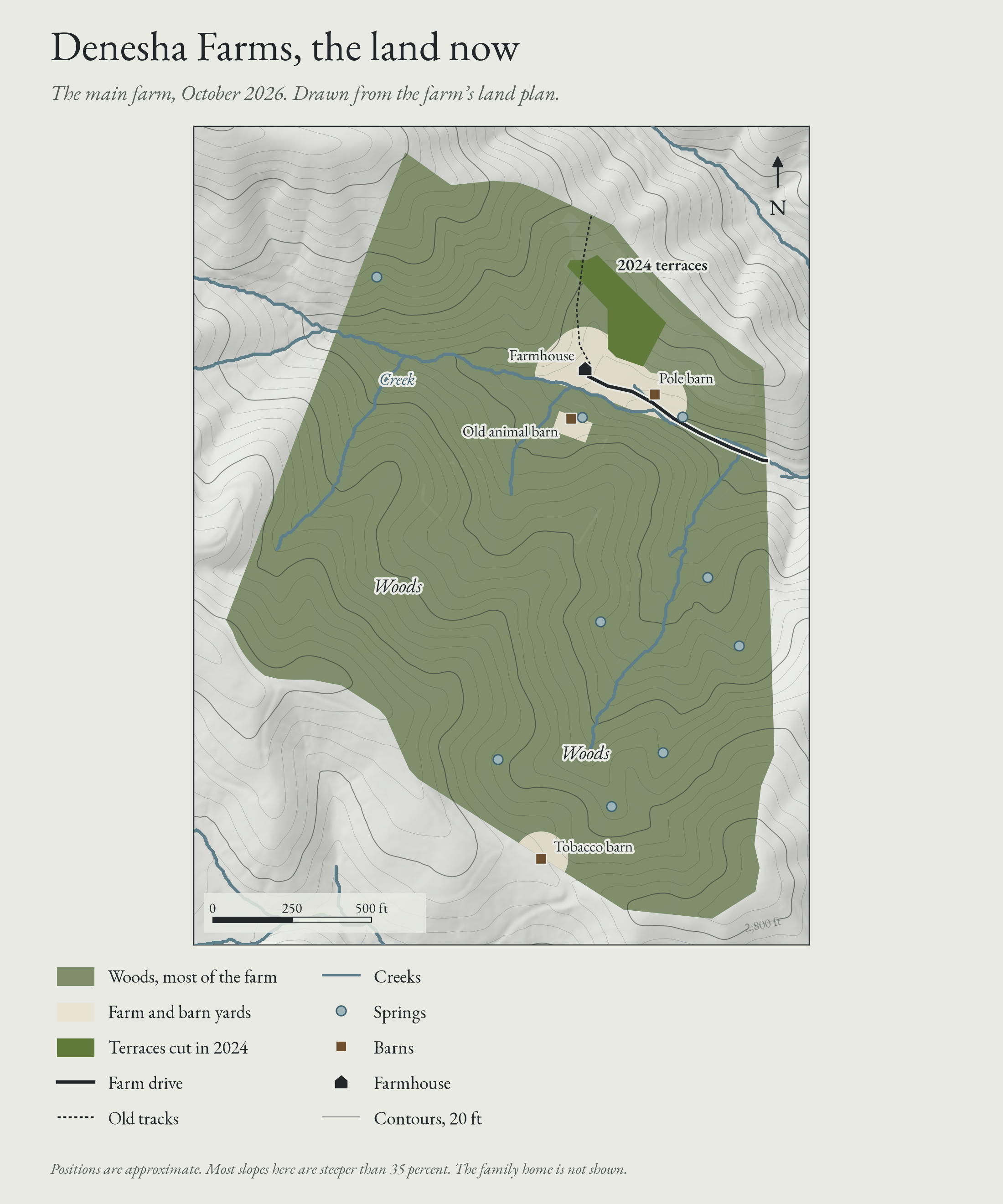
How the land is divided
- Vineyard
- Block A, 2.72 acres, on the south slope above the farm yard: the first acre in 2027 and the rest in 2028. Blocks D and J, about 1.9 acres, are across the creek and are planted in 2031. With the verjus blocks and one more small block, the vineyard grows to about 6.4 acres by 2033, a block at a time.
- Verjus
- Two small blocks on cooler west slopes, K and P, about 1.2 acres, planted in 2029. The grapes are picked green for verjus.
- Old timber
- About 3.3 acres of older forest on rocky ground. It was once marked for vines. It will not be cleared.
- Wild forest
- About 29 acres left alone.
- Woodlot
- Forest that is thinned a few trees at a time for the farm sawmill: posts, stakes, siding and barn timber.
- Paddocks
- Wooded pasture where the sheep and goats are moved in rotation.
- Goat browse
- Brushy ground around the vineyard that the goats keep open.
- Creek buffers
- 50 feet on each side of the creeks, left in trees and brush.
- Yards
- The farm yard, with the farmhouse, pole barn, sawmill and hoop house. The farmhouse will become the farm office and tasting room. The barn yard across the creek, with the old animal barn, spring house and shop. The tobacco barn yard at the top.
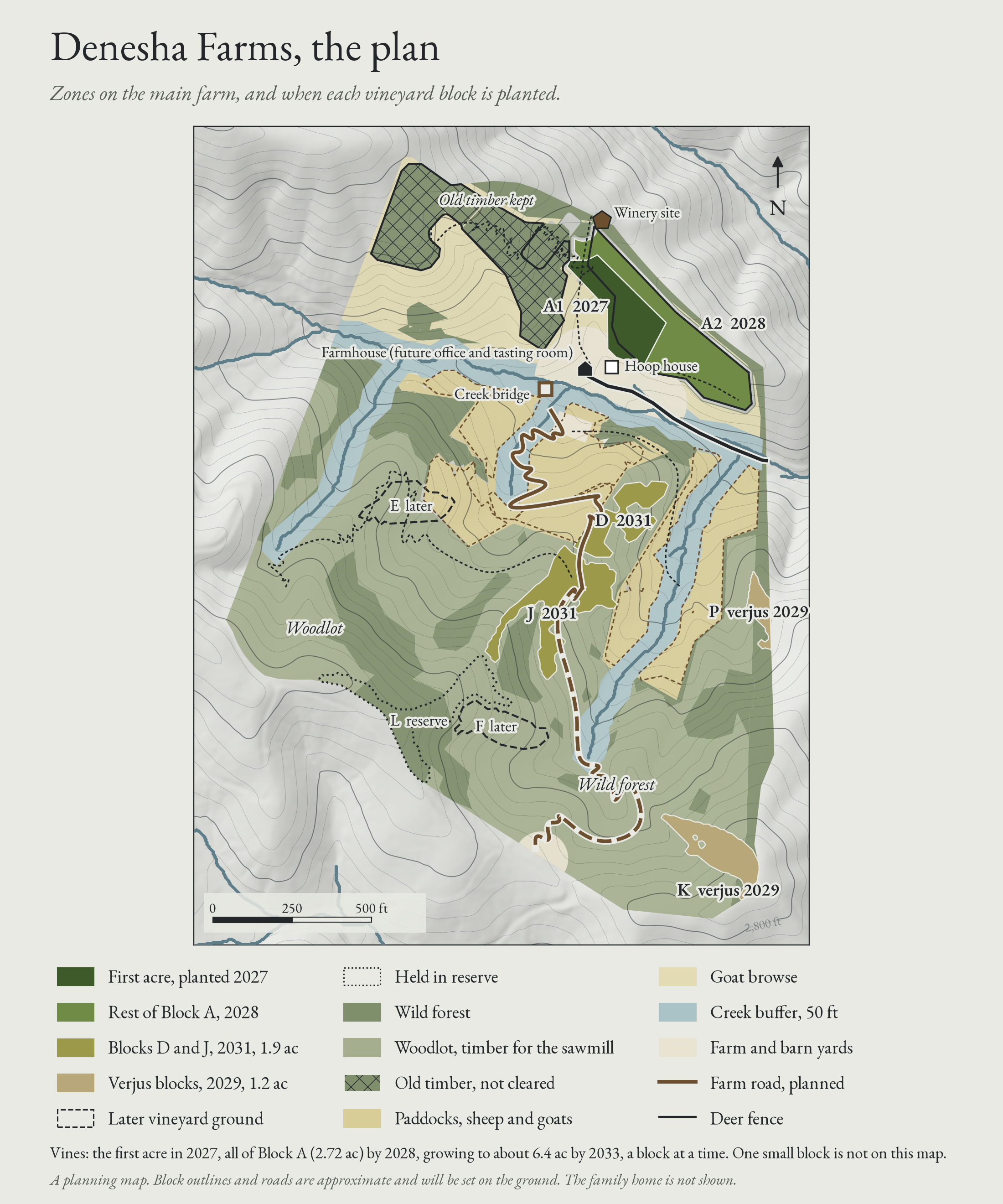
What gets done when
- 2026 to 2027
- Set up the salvaged 30 by 10 foot hoop house for rooting cuttings. Put a roof on the old animal barn before winter. Smooth and surface the steep first stretch of the drive. Fence Block A. In spring 2027, plant the first acre on the 2024 terraces: 840 vines on 1,440 stakes, early ripening hybrids including Seyval Blanc and Maréchal Foch.
- 2028
- Plant the rest of Block A. Fill the gaps in the first acre by layering from neighboring vines, in 2028 and 2029. Build the creek bridge and the farm road to the paddocks. Put a foundation and a new roof on the animal barn. A small hydro turbine, if a year of flow numbers supports it.
- 2029 to 2030
- First crop from the first acre in 2029. Plant the verjus blocks in 2029 and pick the first verjus in 2030. Build a small winery at the top of Block A. Finish the upper farm road to the tobacco barn.
- 2031 to 2033
- Plant Blocks D and J under one fence in 2031, bringing the vineyard to about 6.4 acres by 2033. Use the tobacco barn as a drying shed. After 2032, decide whether more ground goes into vines, and review the whole plan.
The plan will change. Field Notes follows the work as it happens.